1차시험 공부하다 기출 풀면서 그때그때 공부한 거 정리한 자료들이라 좀 맥락이 없고 뒤죽박죽이긴 하지만 뭐 알아서들 봐주십셩
피스톤을 포함한 원통 박판부재
다음과 같은 예제에서,
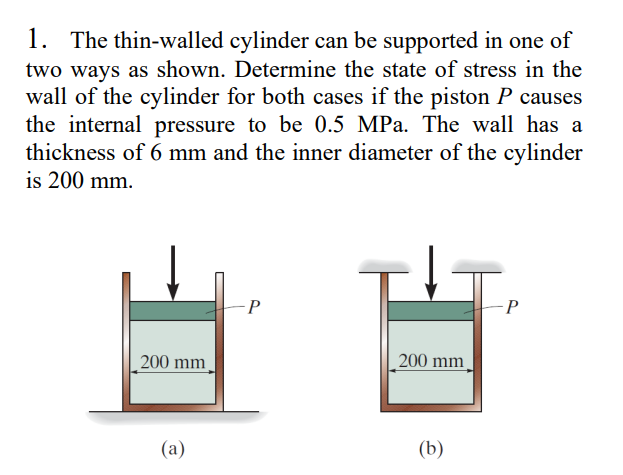
(a)와 (b)를 비교하려면 근본적으로 "응력은 왜 생기는가?"에 대한 질문을 해야 한다.
결론적으로 문제의 정답같은 경우 (a)에서는 원주방향 응력만 발생하고 (b)에서는 원주방향 응력에 더해 축방향 응력도 생긴다.
문제 해설의 경우 이것도 저번에 올렸던 그 아저씨가 친절히 설명해주고 계신다.
https://www.youtube.com/watch?v=ivpofYBIRI4
근데 위에서 설명하는 건 간단한 해설일 뿐이고
결국 축방향 응력이 발생하느냐 발생하지 않느냐는 부재가 어떰 식으로 힘을 받고 있는지, 즉 어떻게 눌리고 있는지를 전체적으로 판단할 수 있어야 한다,
밑의 링크에 자세한 설명이 있는데 참고하면 좋을 것 같다,
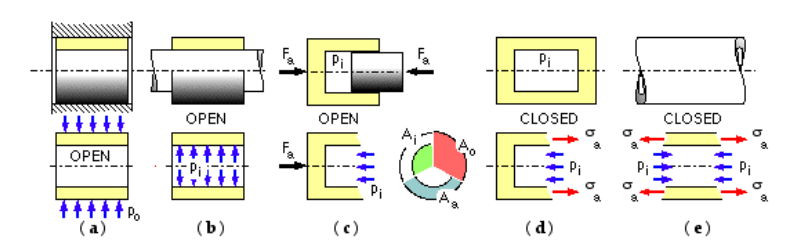
요점은 원통부재 즉 실린더가 Open 상태에 있는지 Closed 상태에 있는지를 구분해야 한다는 것이다.
Cylinders are classed as being either :
open - in which there is no axial component of wall stress,
or closed - in which an axial stress must exist to equilibrate the fluid pressure.
https://www-mdp.eng.cam.ac.uk/web/library/enginfo/textbooks_dvd_only/DAN/cylinders/thin/thin.html
DANotes: Cylinders: Thin cylinders
CYLINDERS Cylinders find many applications, two of the most common categories being : -fluid containers such as pipes and pressure vessels - interference-fitted bearing bushes, sleeves and the like. Cylinders can act as beams or shafts eg. ( load building
www-mdp.eng.cam.ac.uk
영어로 되어 있긴 한데 아래 html 링크로 들어가면 다양한 Cylinder 부재(박판 상황과 그렇지 않은 상황 포함해서)에 대한 상세한 설명이 있다.. 매우 유익함,
https://www-mdp.eng.cam.ac.uk/web/library/enginfo/textbooks_dvd_only/DAN/cylinders/home.html#top
DANotes: Cylinders : Index of topics
www-mdp.eng.cam.ac.uk
전단류 (Shear Flow)
전단류(Shear Flow)라는 건 5장에서 처음 등장하고 7장에서 다시 나오는 개념이다.
사실 전단응력의 개념을 배운 뒤에 전단류라는 개념을 배워서 그렇지 직관적으로 본다면 전단응력이 아니라 전단류가 더 직관적으로는 이해하기 쉬운 개념이라고 생각한다...

이전 글에서도 적어놨듯이 '단위 길이당 전단하중'을 의미한다. 따라서 전단류의 단위는 N/m 이다.
다양한 단면에서의 전단흐름
전단류는 말 그대로 흐름이라, 관련 문제를 풀다보면
(1) 조립부재(Built-up Members) 혹은 (2) 직사각형이나 원형이 아닌 단면 이 주어지는 경우가 대부분이다. 자주 나오는 단면형상에 대해 전단류가 어디서 시작되어 어떻게 흐르는지 알아두면 좋을 것 같아서 가져왔다.

사진 출처는 아래 링크에 있습니다.
http://www.engineeringcorecourses.com/solidmechanics2/C3-transverse-shear/C3.1-shear-flow/theory/
Theory | C3.1 Shear Flow | Solid Mechanics II
Without further ado, let’s look at the formula: Note: V is the shear force acting on the cross-section (units: N) Q = Aȳ and it’s the same Q as in transverse shear (units: m3 or mm3) I is the moment of inertia (units: m4 or mm4) It’s pretty much the
www.engineeringcorecourses.com
여기도 괜찮아보여서 가져옴
https://www.mechref.org/sol/transverse_shear/?origin=sidebar
Transverse Shear
Equilibrium. $$ \begin{align*} &F_x = \int\sigma_x dA = 0 &M_x &= \int(y\tau_{xz} - z\tau_{xy})dA=0 \\ &F_y = \int\tau_{xy} dA = -V &M_y &= \int z\sigma_{x} dA = 0 \\ &F_z = \int\tau_{xz} dA = 0 &M_z &= \int(-y\sigma_{x})dA = M \\ \end{align*} $$ Symmetry
www.mechref.org
https://www.ae.msstate.edu/tupas/SA2/chA14.6_text.html
Section III.3
Section III.3 Section III.3 Flexural Shear Stress and Shear Flow Derivation: Consider a cantilever beam with a symmetric cross section subjected to a lateral (or transverse) force P at the tip. The shear and normal stresses induced by this force are requir
www.ae.msstate.edu
오늘 공부 여기서 끝..
'4대 역학' 카테고리의 다른 글
| [재료역학] 못의 체결 원리와 전단류의 계산 (0) | 2026.04.09 |
|---|---|
| 고체역학(2): 재료역학 8장 조합하중 (0) | 2025.09.28 |